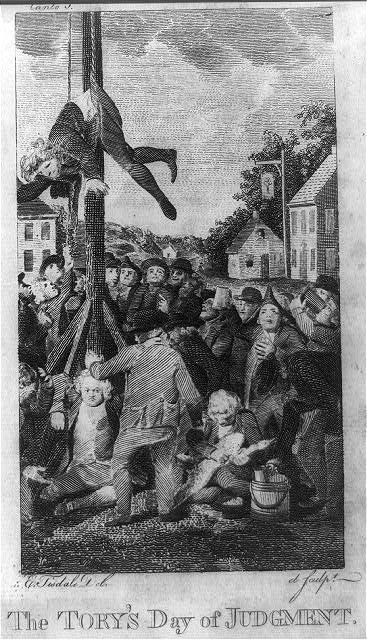
“The Tory’s Day of Judgment,” c. 1783
Though often overshadowed by the Patriot narrative, Loyalists played a central role in Revolutionary Georgia, particularly in regions tied to royal authority, commercial exchange, and the defense of slavery. Loyalist support was especially strong in Savannah, the colonial capital, where many merchants, royal officials, and Anglican elites viewed rebellion as a direct threat to economic stability and social hierarchy.
Loyalist sentiment, however, was not confined to the coast. Support for the Crown extended across the colony, particularly in coastal parishes where rice and indigo planters were economically dependent on imperial markets and fearful of revolutionary upheaval. In the backcountry, too, British loyalty found fertile ground. Areas like Augusta—a key hub for Native diplomacy and the deerskin trade—saw Loyalist strength among Indian agents, traders, and settlers who had long relied on British alliances and protections. In both regions, local militias raised in defense of the Crown clashed with Patriot forces, revealing a revolution that was not just anti-colonial, but deeply civil in nature.
The turning point came in 1782, when British forces evacuated Savannah and revolutionary authorities regained full control of the colony. In the aftermath, Georgia’s new leadership targeted Loyalists through confiscation acts, seizing lands, homes, and plantations. This was not limited to the coast: Loyalists across the interior faced exile, economic ruin, and political erasure.
Thousands fled the colony, seeking refuge in East Florida, the Bahamas, Nova Scotia, or Britain. Many left behind generational landholdings, only to face uncertain futures in unfamiliar places. Their property was redistributed through public auction, often awarded to revolutionary soldiers, officials, and political allies.
The Loyalists map visualization on this site documents this often-forgotten side of the Revolution: where Loyalists lived, how they served, and what they lost. By tracing their geographic spread—from Savannah to the interior—it reveals the depth of loyalty to the Crown and the far-reaching consequences of choosing the losing side.